
An Upset Victory in Thailand

This article is co-authored by Lynn Lai and Luo Xuhong. Cover image by Yang Ruimin.
*This article is published in collaboration with Doomscroll Diplomacy, your next one-stop platform for all things foreign affairs. Check out Doomscroll Diplomacy's telegram channel here.
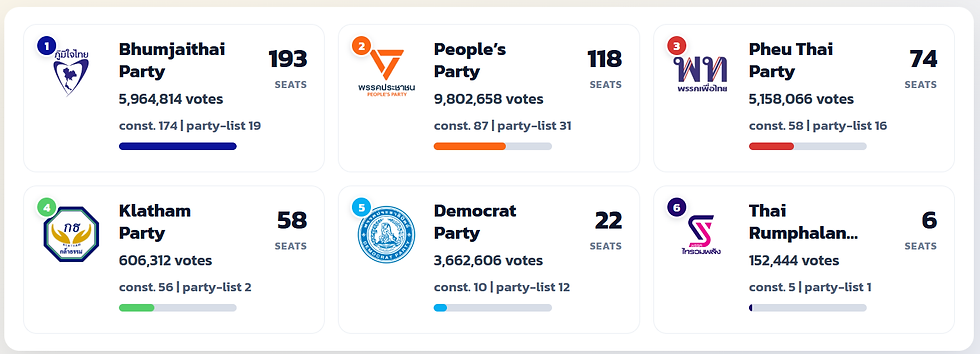
As the dust settles, the recently concluded Thailand elections has yielded surprising results that are poised to shape the landscape of Thai politics for years to come. Defying many opinion polls, Anutin Charnvirakul’s Bhumjaithai party (BJT) swept to a resounding victory over the progressive-leaning People’s Party (PP), securing a total of 193 seats in the 500-member House of Representatives while the Shinawatra-dominated Pheu Thai Party came in a distant third-place.
How did the conservative-leaning BJT, with its roots as an amalgamation of regional powerbrokers and former junior coalition partner to Pheu Thai, flip the tables this time round?
The story goes back to the tumultuous months of 2025. Sparked by a leaked phone call between then-PM and Pheu Thai leader Paetongtarn Shinawatra and Cambodian Senate President Hun Sen, Paetongtarn was widely condemned for what appeared to be her criticism of the Thai military and apparent deference to Hun Sen. Forced to step down over the embarrassing audio recording, the unfolding political crisis eventually culminated in a Constitutional Court ruling that affirmed her dismissal from the Prime Minister post over ethics violations in end-August.
The resultant political paralysis saw BJT’s interior minister Anutin seeking the support of the People’s Party (PP) for his role in replacing Paetongtarn in exchange for his promise to hold elections within 4 months. Crucially, Anutin also agreed to help advance PP’s constitutional reform bill on section 256, a bill that aimed to reduce the influence of unelected military-linked figures in Thai politics.
Since assuming the post of Prime Minister, Anutin has adopted a hawkish approach to the Thai-Cambodia crisis. Despite signing the Kuala Lumpur Peace Accords, border tensions never fully eased and outbursts of violence along border areas have flared on a weekly basis. In response, Anutin positioned the BJT as a firm partner of the Thai military, publicly rejecting the prospect of further negotiations with Cambodia and demanding that Phnom Penh meet on Thai terms before the conflict could see an end.
Yet, the new coalition agreement between BJT and PP did not last for long. In a move that caught many by surprise, BJT senators voted against the PP’s constitutional amendment bill when tabled in parliament, scuttling it by a narrow margin. Faced with PP’s no-confidence vote, Anutin ordered parliament to be dissolved and called for snap elections scheduled for February 2026.

Resurgence of the Blue Wave
Now that we have examined the background context of the Thai election, let’s take a closer look at the strategies adopted by the leading contenders.
Riding on the rally-around-the-flag effect, the BJT appealed to the patriotism of the Thai electorate by framing the election as a choice between Thailand’s security and political reforms. As the election drew closer, the BJT floated more radical proposals such as a border wall and took pains to emphasise that Phnom Penh would be expected to face the full force of Thailand’s superior military.
People’s priorities have shifted from reform to the need for stability. -Tita Sanglee, Associate Fellow, ISEAS
In contrast, the PP suffered from a crisis of mixed messaging. Its longstanding criticism of the military’s involvement in politics has soundly backfired amidst a resurgence in patriotism. Stepping away from previous demands to abolish conscription, the PP was forced to clarify that “it had never been against the military as an institution”. Even then, the PP found itself unable to replicate its success in 2023 - its core support base of youth voters viewed moves to tone down the rhetoric as “brand dilution” and appeared to be less enthusiastic in supporting the progressive party this time round.
However, nationalism alone does not explain the scale of BJT’s win either. A closer analysis of electoral results reveals the BJT’s ability to fall back on its close ties with the Baan Yai (powerful political families active in provincial politics). Once more, patronage networks played a driving role in vote-canvassing for BJT across Thailand’s rural heartland, where village representatives and volunteers offered largesse (cash handouts are officially prohibited, but nevertheless a common occurrence) and dangled development projects on the campaign trail.
BJT’s success is intricately linked to Thailand’s split-ticket voting system as amended in the 2023 constitution, where voters cast 1 ballot each for Members of Parliament representing their constituency and Members of Parliament in the party-list race respectively. A study of the 2023 results has revealed that voters do not necessarily choose the same candidate: voters often support local candidates aligned with aforementioned patronage networks while party-list ballots are usually cast based on broader ideological alignment or perceptions of competence.
Proving once more that it commanded strong support among urban middle-class Thais, PP swept all 33 seats in Bangkok and made large gains in the second largest city of Chiang Mai in this election. Yet, PP was unable to replicate this trend outside of urban districts, where PP’s representatives - termed political outsiders - were virtually unknown as compared to the Baan Yai-allied BJT candidates.
Keenly aware of its reputation as a party reliant on patronage networks, BJT has also attempted to distance itself from its old image. The surprise introduction of 3 technocrats to lead policy direction across the key Foreign Affairs, Commerce and Finance portfolios reveals a strategic pivot towards appealing to the educated urban-middle class voter that would typically vote for the progressive PP. At the last BJT election rally, the technocrats burnishing their establishment credentials and made promises to lead a refreshed BJT in 2026.
Real Change Afoot?
The election is over and the real work begins. What remains are the problems that preceded it: a slowing economy, a half-built industrial strategy, and a constitutional change that Anutin has every incentive to stall.
Thailand sources 74% of its oil from the Persian Gulf, and about 21% of its LNG from Qatar - both of which pass through the Strait of Hormuz to reach Thailand. Oil reserves are drying up, with state reports claiming that Thailand currently has enough oil to last for only 61 days. That number is less reassuring as it sounds. Japan holds reserves for 254 days; South Korea and China for 208 and 120 days respectively.
The immediate impact was sharp. The state-run oil fuel fund is now being used to subsidise diesel, and it is losing more than US$32 million a day. According to cabinet documents, the accumulated losses on these subsidies may reach US$320 million by 18 March. Anutin capped diesel prices, encouraged civil servants to work from home, and banned oil exports. Such policies are merely quick (and small) wins, consistent with the policies the BJT’s spiritual predecessor, Thaksin Shinawatra’s infamously populist Thai Rak Thai party pushed. The problem however, is that maintaining low prices for diesel is expensive and Thailand’s budget is already strained. Public debt sits at 65.96% of GDP, its highest in two decades.

Each Baht spent keeping fuel cheap is a Baht unavailable for the structural investment the economy actually needs. Anutin, having campaigned on populist issues like the rising cost of living, has no incentive to redirect spending to fix what ails the sluggish Thai economy. What ails it runs deeper than any industrial strategy can reach.
In 2024, the World Bank found that 65% of Thai youth and working-age adults fall below literacy levels, and 74% lack essential digital skills. In the 2022 PISA results, only 32% of 15-year-olds reached minimum proficiency in mathematics - against an OECD average of 69%. Thailand produces a fraction of the top-tier mathematics performers that regional leaders in innovation do - Singapore (41%), Taipei (32%), Japan (23%) and Korea (23%). Evidently, Thailand does not have the building blocks of a semiconductor economy. They merely have the foundations of one that assembles chips rather than design them.

The problem starts in the classroom, but not for lack of spending. According to a 2016 OECD-UNESCO Review on Thailand’s Education Policy, Thailand’s expenditure on education is among the highest in the region, with particularly substantial investment at the pre-primary and primary levels. The money has translated into access: enrolment is up, and students enter the system with genuinely positive attitudes toward learning. What it has not translated into is outcomes. The gap between input and results points to a system that is inefficient and deeply unequal - children from lower-income households and rural areas are not only more likely to perform poorly, but more likely to attend underfunded schools without qualified teachers in the first place.
This is the binding constraint that no industrial strategy can work around. Paetongtarn's semiconductor roadmap assumed a workforce that Thailand's education system is not yet producing. Anutin has reaffirmed the agenda, but reaffirming a strategy does not resolve the human capital problem underneath it. Reforming the education system means disrupting entrenched bureaucracies, retraining teachers, and accepting that results will take a generation to materialise. None of those are attractive propositions for a government whose political horizon extends to the next election.
We remain pessimistic as to whether Anutin will deliver the constitutional reforms that the Thai want to see. Thailand has been governed since 2017 by a constitution written by military junta, drafted in the aftermath of the 2014 coup that removed the elected government of Yingluck Shinawatra. The document had one goal - make it structurally difficult for elected governments to govern without the blessing of the military and the crown. It achieved this through establishing an unelected Senate with the power to block legislation, creating independent oversight bodies whose members were appointed by the junta, and electoral rules that fragmented opposition parties. In short, it is a constitution written by the people currently in power, to stay in power.
Running alongside the February 8 election was a referendum on whether to scrap it. Over 65% of voters said yes, with majorities in nearly 70 of Thailand's 77 provinces, including many districts that voted conservative in the parliamentary race. The process must now begin. That much is constitutionally obligated.
But beginning the process and delivering meaningful reform are very different things. The referendum mandated that a new constitution be drafted. It said nothing about what that constitution must contain. The real battleground is the composition of the drafting assembly - whether it is dominated by elected civilian representatives or by figures acceptable to the establishment. BJT holds influence over appointments to the Constitutional Court, the Election Commission, and the oversight bodies that govern that process.
The BJT is not a military party in the straightforward sense. It lacks the ideological lineage of the junta-backed parties that collapsed in the 2026 elections. Rather, the BJT is better understood as opportunistically conservative. Anutin is not with the military so much as he is dependent on their tolerance. Moving too fast on constitutional reform would cost him the establishment backing that keeps him in power. He has every incentive to ensure reform happens in form - a new document will eventually exist - but not in substance. The unelected Senate, the junta-appointed oversight bodies, the monarchy provisions: these are the architecture of the existing order, and that order is what Anutin's political survival depends on preserving.
The People's Party will push hard from opposition. But they are weakened, and the institutional terrain they are fighting on is not neutral. A population that voted clearly for meaningful reform will watch that reform be managed, diluted, and eventually filed away under a new name.
References
Alexander, S. (2025). “Vote for who you like; fight for the right party”: A case study of voting reasons in Thailand’s Northeast in the 2023 general elections. Journal of Current Southeast Asian Affairs, 44(2), 204–221. https://doi.org/10.1177/18681034251337764
Bangkok Post. (2025, October 11). People’s Party push for reform. Bangkok Post. https://www.bangkokpost.com/thailand/politics/3119414/peoples-party-push-for-reform
Bishop, S. (2026, March 2). Thailand’s referendum victory keeps door to constitutional change open. East Asia Forum. https://eastasiaforum.org/2026/03/02/thailands-referendum-victory-keeps-door-to-constitutional-change-open/
Board, J. (2026, March 10). How exposed is Southeast Asia’s energy supply to the Iran war - who is most vulnerable and what’s next? CNA. https://www.channelnewsasia.com/asia/iran-war-us-oil-liquefied-natural-gas-prices-5983251
Hale, E. (2026, February 7). Will pro-military message bring Thailand’s “most hawkish” party to power? Al Jazeera. https://www.aljazeera.com/news/2026/2/7/will-pro-military-message-bring-thailands-most-hawkish-party-to-power
Head, J. (2025, December 27). Thailand-Cambodia ceasefire begins after weeks of deadly clashes. https://www.bbc.com/news/articles/c0q5je8048xo
Head, J. (2026, February 24). Political outsiders are up against Thailand’s powerful patronage system, defeated MP tells BBC. BBC. https://www.bbc.com/news/articles/cg4gxng2y4xo
Hutt, D. (2025, March 12). What’s Behind Thailand’s Planned Border Wall With Cambodia? The Diplomat. https://thediplomat.com/2025/03/whats-behind-thailands-planned-border-wall-with-cambodia/
Jatusripitak, N., & McCargo, D. (2026, March 3). Rebranding Bhumjaithai. FULCRUM. https://fulcrum.sg/rebranding-bhumjaithai/
OECD. (2023). PISA 2022 Results Factsheets Thailand. https://www.oecd.org/content/dam/oecd/en/publications/reports/2023/11/pisa-2022-results-volume-i-and-ii-country-notes_2fca04b9/thailand_b136aea5/6138f4af-en.pdf
OECD/UNESCO. (2016). Education in Thailand: An OECD-UNESCO Perspective, Reviews of National Policies for Education. OECD Publishing. https://www.oecd.org/content/dam/oecd/en/publications/reports/2016/08/education-in-thailand_g1g6a08c/9789264259119-en.pdf
Teng-Westergaard, C. (2026, March 15). The Hormuz buffer: Asian oil security amid prolonged Middle East conflict. RNZ News. https://www.rnz.co.nz/news/world/589660/the-hormuz-buffer-asian-oil-security-amid-prolonged-middle-east-conflict
Thai PBS World. (2025, December 26). Bhumjaithai, People’s Party come to end of the road? Thai PBS World. https://world.thaipbs.or.th/detail/bhumjaithai-peoples-party-come-to-end-of-the-road/59995
Thai PBS World. (2026, March 1). Thailand’s current oil reserves will last 61 days - Energy Ministry. Thai PBS World. https://world.thaipbs.or.th/detail/thailands-current-oil-reserves-will-last-61-days-energy-ministry/60568
Thanthong-Knight, R. (2026, March 11). Thailand’s Oil Fund Burns $32 Million A Day to Cap Diesel Prices. Financial Post. https://financialpost.com/pmn/business-pmn/thailands-oil-fund-burns-32-million-a-day-to-cap-diesel-prices
The Nation Thailand. (2025a, December 8). Anutin rules out talks, demands Cambodia meet thai terms. The Nation Thailand. https://www.nationthailand.com/news/general/40059416
The Nation Thailand. (2025b, December 11). House in chaos as Bhumjaithai breaks with People’s Party over Senate charter powers. The Nation Thailand. https://www.nationthailand.com/blogs/news/politics/40059631
Wee, S.-L. (2026, February 7). What to Know About Thailand’s Election. The New York Times. https://www.nytimes.com/2026/02/07/world/asia/thailand-election-what-to-know.html
World Bank Group. (2024, February 20). Fostering Foundational Skills in Thailand: From a Skills Crisis to a Learning Society. World Bank Group. https://www.worldbank.org/en/country/thailand/publication/fostering-foundational-skills-in-thailand

Comments