
Fractured Sino-Japanese relations; Lessons for the Indo-Pacific
Updated: Mar 16
Cover image credit: Lyn Pei
Tensions between Japan and China are at their highest point in over a decade.
The previous episodes suggest some clues as to how the following weeks and months may unfold. Nevertheless, the domestic political landscape in both countries has seen significant changes since the 2010 and 2012 episodes over the Senkaku/Diaoyu Islands dispute. According to the Centre for Strategic and International Studies (CSIS), the importance of the Taiwan issue to China and the interdependencies that are associated with the island in East Asia makes any détente more difficult to achieve and even if it does happen, the new status quo will not be as good as the old one.

During the parliamentary questioning session that was held on the 7th of November 2025, the Japanese Prime Minister, Sanae Takaichi, told the parliament that “a contingency in Taiwan could turn into a survival-threatening situation for Japan,” which in essence implies that Japan could invoke the “collective self-defence” rights in order to interfere in the Taiwan issue. In this regard, China’s Ministry of Foreign Affairs immediately summoned the Japanese ambassador in China on the 12th of November 2025 and asked the ambassador to “immediately retract the erroneous statements” that were allegedly made by the Japanese Prime Minister, as revealed by China’s Vice Foreign Minister Sun Weidong.
In addition, economic frictions between China and Japan have also re-emerged at the outset of the new year, with China imposing restrictions on the export of rare earth elements to Japanese industries. This is consistent with previous patterns of China exploiting Japan’s export interdependencies for strategic purposes.
The increasingly deteriorating conflict between China and Japan over Taiwan’s status, which is laced with decades of historical baggage, reflects significant changes in the security landscape of the Indo-Pacific region. In fact, the Chinese government declared its willingness to engage in military action against Japan should it intervene in Taiwan, thus indicating the alarmingly unstable nature of the current international security scenario and the fact that regions such as Southeast Asia are still locked into this unstable security scenario.
A New Equilibrium
For much of the past three decades, China and Japan have enjoyed a relationship that rested on economic interdependence and the diplomatic accords established when relations were normalised in the latter half of the 20th century. The relationship has long been a delicate one, predicated on avoiding issues such as regional security, territorial disputes, military balances, and Taiwan.

The statement by Takaichi has shattered this tenuous status quo by being more explicit about issues that past governments had sought to leave ambiguous. The two countries must now contend with issues that had, until then, been carefully avoided. The timing, moreover, was no coincidence, as security strategies released recently and the 2024 whitepaper on the Defence of Japan had already placed greater importance on Taiwan's place within Japanese security strategies; Takaichi's statement merely gave this diplomatic shift practical form.
China’s response is a deliberate escalation: a coordinated campaign of economic coercion including travel bans affecting half a million tourists, seafood import suspensions and the cancellation of nearly 1,900 flights, not to mention its recently imposed broad ban on the export to Japan of rare earths and powerful magnets containing them. But these measures can be suspended or reversed. It was Beijing’s military response that established an irreversible precedent. By using radar to aim weapons at targets- a threshold previously avoided - Beijing signalled that it was willing to continue to test Japanese and international tolerance, a step further from the past Chinese violations of Japanese airspace.
The possibility of genuine Sino-Japanese reconciliation has withered. The two powers will not sever economic ties; too much mutual prosperity depends on continued trade. They are, however, entering a “managed rivalry” - where official cooperation persists while underlying strategic competition becomes the organising principle. In other words, both capitals will likely maintain diplomatic channels, resume high-level visits once immediate tensions cool and continue bilateral trade. But beneath the surface lies a fundamentally different relationship of cold strategic calculation, periodic economic coercion and military incidents that test each other’s resolve.
From the Taiwanese perspective, the Sino-Japanese rivalry brings new security challenges to Southeast Asia. It escalates rising tensions between alliances and reveals their economic vulnerabilities, challenging ASEAN to demonstrate its cohesive resolve. The region will need to balance major power urges to take sides in the longer term, with the possibility of fragmentation.
Wolf-warrior style of the past
While this approach had somewhat pandered to domestic emotional needs, particularly the rising nationalist sentiment, the confrontational posture triggered major diplomatic pushback, negatively impacting China’s international image. Furthermore, Chinese scholars warned against the “domestication of foreign propaganda” and expressed concerns that the diplomatic space was being hijacked by populist sentiments, and called for a shift away from the wolf warrior image.
As such, in the last couple of years, China’s diplomatic style has changed, with the wolf warrior element and aggressive rhetoric gradually declining. The Economist used an AI model to analyse 16,000 press conference exchanges by China’s Ministry of Foreign Affairs since 2018, assessing a “wolf warrior index” from 0 to 1. According to the report, the ministry’s responses became noticeably more assertive from 2019, with aggressiveness rising from below 0.3 in 2018 to over 0.45 in May 2021. However, the index has steadily declined since mid-2022, reaching a level of cordiality earlier this year that has not been seen in nearly six years.
Why Now?
The roots of this conflict are long and complex. China sees Taiwan not just as a territory, but as a non-negotiable line on its national survival. Any form of intervention from the outside world, therefore, amounts to an invasion and breach of its territorial boundaries. On the other hand, Japan’s security scenario is undergoing a transition with its increasing commitment towards the United States’ Indo-Pacific policy. The 2023 United States and Japan Security Consultations formalised the joint deterrence policy towards China in the Taiwan Strait, a milestone in Japan’s security policy.
In 2024, Japan recorded its highest defence budget since World War II, amounting to 2% of its GDP. This marked a transition from its policy of pacifism. This was also evident from the public opinion, with 68% support for strengthening defence ties with the United States in the first half of 2025, due to the Russian invasion of Ukraine in 2022. China, on the other hand, has energetically built its military capabilities with a $300 billion defence budget in 2025.
How has Taiwan Responded?
Taiwanese President Lai Ching-te, from the pro-independence Democrat Progressive Party, claimed that China was conducting a "multifaceted attack" against Japan, which is greatly affecting the peace and stability of the Indo-Pacific region. The KMT is known for its ideologies, which emphasised strengthened relations between Taiwan and China. He urged the international community at large to keep a close eye on the situation, but at the same time urged China not to be a troublemaker for peace and stability but instead be a role model for a responsible country.

"China should return to a rules-based international order; only then will it be helpful for the region's development. We ask China to think twice." A former legislator of the opposition Kuomintang (KMT) Party said in an interview with China Global Television Network on Sunday that Takaichi's statements risk dragging Taiwan into a crisis it can neither afford nor control.
According to Joanne Lei, Takaichi's comment did not lean on a united Taiwan. In fact, it struck at one of Taiwan's deepest internal divides. Takaichi’s remarks are worrying for the KMT and Taiwanese voters who oppose formal independence, she added, not because Japan's support had the possibility of being an empty promise, but because it could have encouraged Taiwan independence advocates to take unnecessarily reckless steps.
“One-China policies” in the East Asian Sphere
Southeast Asian countries also have their own “one China” policies – determined as they see fit – to manage ties with Beijing and Taipei. These often do differ from the positions articulated by China, Japan or each other.
Like Japan, however, ASEAN cannot simply avert the fallout from a possible major crisis surrounding Taiwan simply because of geography. A multitude of questions over how major powers may relitigate and reinterpret international laws and understandings remain unanswered.
How the current Japan-China spat plays out may well affect the longer-term interests of third parties in the wider region in unfamiliar and less comfortable ways. These countries may wish to reference current tensions between Tokyo and Beijing and thus consider how best to protect their equities and manage their vulnerabilities in a more uncertain, contentious and coercive world.
The situation is even getting tougher as the economy continues to struggle because of these issues. The Taiwan Strait is one of the most important routes in the world, as it carries about 40 percent of the world’s container traffic, and therefore, if it ever comes to a halt, the economy of Southeast Asia, which is export-oriented, will be in some kind of disorder. Moreover, Taiwan alone houses over half of the world’s most advanced chip producers, including TSMC, which is used by Southeast Asian nations like Malaysia and Vietnam to make their electronic products, and thus Taiwan is not just causing chaos in the security arena but is also having an overall negative impact on the economy.
The ASEAN Dilemma
ASEAN faces growing challenges to its unity because of these developments. The different national priorities between Vietnam, Indonesia and Thailand make it difficult to achieve consensus.
Vietnam takes a careful approach to balance its position, maintaining strategic autonomy while benefiting from both relations. Despite rising US-China tensions, an overt shift for Vietnam toward one side remains impractical. In addition, as the largest country in Southeast Asia in terms of size and population, Indonesia traditionally has not been inclined towards any prominent presence of the world’s major powers in the region. There is a perception that such a presence would dilute Indonesia’s own role as the region’s major power. Furthermore, Thailand switches between defensive strategies and cooperative actions because for Thailand, Southeast Asia should neither be a region dominated by any single extra-regional power nor a region of bipolar rivalry between two powers, but a region of multiple and multilateral engagement and cooperation by all involved major powers.
The ASEAN Outlook on the Indo-Pacific, which was reaffirmed in 2025, serves as an aspirational document, but it does not have any enforcement mechanisms, which exposes the region to external influences. The 19th and 20th century historical records present additional difficulties because Southeast Asian nations handle Japan’s wartime past with care, yet Malaysia and Indonesia back China’s military stance against Japan because they question Japanese military ambitions.
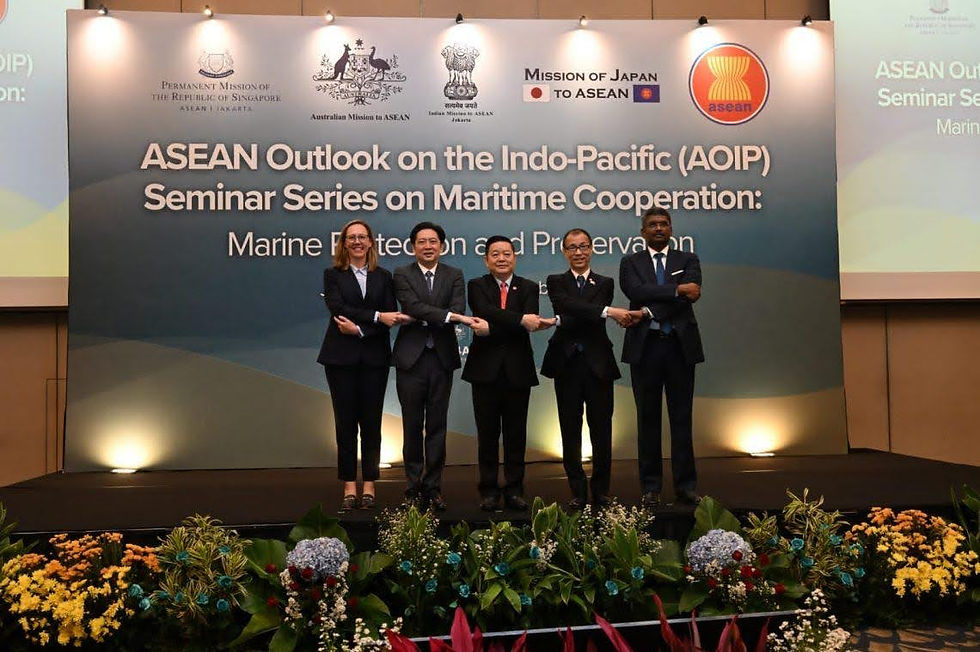
The road ahead is fraught with real and growing challenges. The region could become a theatre for great power brinkmanship, where major powers will be testing each other’s mettle over the issue of Taiwan. ASEAN’s structural weaknesses could potentially lead to fragmentation and undermine ASEAN’s grip over regional diplomacy.
The region’s economic relationships with China and Japan, and with the US, will be laced with dependencies that are difficult to shed and even harder to ignore. The region will remain vulnerable to outside threats because ASEAN does not have a comprehensive security strategy that provides for assured defence. The hard truth, however, is that all of this will not be easy and quick as long as big powers like China and the US are present in Southeast Asia. ASEAN, in its present form, does not have the military power behind many of its members, like Myanmar and Laos, making the region more vulnerable.
Security partnerships in the region must evolve because middle powers like India and Australia offer independent solutions which help countries decrease their need for Chinese or U.S.-Japan alliance support. The South China Sea and Strait of Malacca need naval capability investments and joint patrols to create maritime resilience for protecting essential sea lanes. ASEAN should try to use narrative diplomacy as a tool to fight against the historical narratives of great powers while creating its own vision for peace, economic stability, and neutrality.
Regardless of the ASEAN response, current relations between China and Japan mirror a broader process of international order transformation that had taken place in the 19th century after the first Sino-Japanese War. And with the scale of the Liberal Democratic Party’s (LDP) recent victory under Takaichi, it can be reasonably assumed that Japan’s flexibility in conducting its China policies is likely to narrow.
The effect of the supermajority reduces the incentive for internal balancing, emphasises hawkish rhetoric, and prioritises security over economic concerns. However, this does not suggest that Japan's China policy will display a linear pattern. While diplomacy, security, and economic policies are not always synchronised, the general trend points in the direction of deterrence and signalling.
The electoral results in Japan redefine the domestic politics in Tokyo and increase the stakes in the stability of the region. The key question is whether the emerging situation will create a security spiral in relations with China based not on the electoral rhetoric but rather the day-to-day decision-making processes. The first step is to actually look beyond the debate about whether the relationship is deteriorating and instead focus on what is actually moving and how to respond to these changes before a self-reinforcing dynamic takes hold.
Fundamental questions lie behind each individual contentious issue - which will shape the rules and dynamics in East Asia over the coming decades.

Bibliography
Adachi, A. (2025). The ambiguities of economic competition with China in the Indo-Pacific. German Marshall Fund of the United States.
ASEAN. 2021. “ASEAN Outlook on the Indo-Pacific.” https://asean.org/wp-content/uploads/2021/01/ASEAN-Outlook-on-the-Indo-Pacific_FINAL_22062019.pdf.
Analysis: A Taiwan Crisis Could Trigger an Unprecedented China–Japan Clash - Vision Times.” Vision Times. November 19, 2025. https://www.visiontimes.com/2025/11/19/analysis-a-taiwan-crisis-could-trigger-an-unprecedented-china-japan-clash.html.
CNA, 2025. “How China-Japan Relations Took a Sharp Downturn after a Single Remark by PM Takaichi.” 2025. https://www.channelnewsasia.com/east-asia/china-japan-tensions-sanae-takaichi-travel-taiwan-5471656.
CNA, 2025. “Commentary: Japan-China Tensions Signal Uncomfortable Changes in Asia.” 2025. https://www.channelnewsasia.com/commentary/china-japan-tensions-taiwan-situation-resolve-5624086.
Danxu, Yang. 2025. “A Wolf Warrior Returns: How a Single Post Shook China–Japan Relations.” ThinkChina - Big Reads, Opinions & Columns on China. Think China. November 12, 2025. https://www.thinkchina.sg/politics/wolf-warrior-returns-how-single-post-shook-china-japan-relations.
“DEFENSE of JAPAN Pamphlet.” n.d. https://www.mod.go.jp/j/press/wp/wp2024/pdf/DOJ2024_Digest_EN.pdf.
Goh, Evelyn, Herman Joseph S. Kraf, Irman G. Lanti, Teo Kah Beng, Zakaria Haji Ahmad, Chulacheeb Chinwanno, Le Linh Lan, Sisowath Doung Chanto, Alice D. Ba, and David Capie, eds. 2005. BETWIXT and BETWEEN. Nanyang Technological University: Institute of Defence and Strategic Studies.
Kim, Hong N. 1975. “Sino-Japanese Relations since the Rapprochement.” Asian Survey 15 (7): 559–73. https://doi.org/10.2307/2643340.
Lawal, Shola. 2025. “China Spat with Japan on Taiwan Deepens, Reaches UN: What’s It All About?” Al Jazeera. November 22, 2025. https://www.aljazeera.com/economy/2025/11/22/china-spat-with-japan-on-taiwan-deepens-reaches-un-whats-it-all-about.
Las Heras, Paula, Nathalia Murphy, and Ana Ramos. n.d. “STRATEGIC ANALYSIS REPORT MAY 2024 VIETNAM against the Winds Holding Strong of a Multipolar World.” https://www.unav.edu/documents/16800098/17755721/vietnam-bamboo-holdings-strong-in-a-multipolar-world.pdf.
Lin, Bonny, and Kristi Govella. 2025. “Escalating Japan-China Tensions: Insights from the Past and Prospects for the Future.” Csis.org. 2025. https://www.csis.org/analysis/escalating-japan-china-tensions-insights-past-and-prospects-future.
McGowan, A. (2025, February 14). China in the Indo-Pacific: January 2025. Council on Foreign Relations.
Ng, Kelly. 2026. “Japan Votes in Snap Election as PM Sanae Takaichi Takes a Gamble,” February 7, 2026. https://www.bbc.com/news/articles/cx2y7d2z29xo.
Reuters Staff. 2026. “China Curbs Rare Earth Exports to Japanese Companies after Dual-Use Ban, WSJ Reports.” Reuters, January 8, 2026. https://www.reuters.com/world/asia-pacific/china-curbs-rare-earth-exports-japanese-companies-after-dual-use-ban-wsj-reports-2026-01-08/.
South China Morning Post, 2026 “South China Morning Post.” February 11, 2026. https://www.scmp.com/opinion/asia-opinion/article/3343001/how-takaichis-landslide-victory-will-reshape-china-japan-security.
The Economist. 2025. “Our New ‘Wolf Warrior’ Index on Chinese Diplomacy.” The Economist. September 18, 2025. https://www.economist.com/china/2025/09/18/our-new-wolf-warrior-index-on-chinese-diplomacy.
The Straits Times. 2025. “Japan, China Ties Deteriorate after Takaichi’s Taiwan Comment.” November 20, 2025. https://www.straitstimes.com/asia/japan-china-ties-deteriorate-after-takaichis-taiwan-comment
U.S. Department of War. “Joint Statement of the 2023 U.S.–Japan Security Consultative Committee (‘2+2’).” 2023. https://www.war.gov/News/Releases/Release/Article/3265559/joint-statement-of-the-2023-usjapan-security-consultative-committee-22/.
Wilkins, Thomas. n.d. “Evolving Security Alignments of the Indo-Pacific: The US Alliances, the Shanghai Cooperation Organisation, and ASEAN ‘Alignment’ as an Ordering Principle for Understanding the Indo-Pacific Security Landscape.” Accessed February 17, 2026. https://www.jiia.or.jp/eng/upload/eng/JapanReview_Vol3_No2_07_Wilkins.pdf.
Yamashita, A. (2025, June 4). China’s expanding threat across Asia. Taipei Times.
Yoo, Jihye. 2025. “Managing a Rivalry: The Latest Japan-China Escalation and What Europe Can Do.” ECFR. European Council on Foreign Relations (ECFR). December 12, 2025. https://ecfr.eu/article/managing-a-rivalry-the-latest-japan-china-escalation-and-what-europe-can-do/.
Yoo, Jihye. 2025. “Managing a Rivalry: The Latest Japan-China Escalation and What Europe Can Do.” ECFR. European Council on Foreign Relations (ECFR). December 12, 2025. https://ecfr.eu/article/managing-a-rivalry-the-latest-japan-china-escalation-and-what-europe-can-do/.
Zhu, Zhiqun. 2020. “‘Wolf Warrior Diplomacy’: China’s New Normal?” ThinkChina - Big Reads, Opinions & Columns on China. Think China. May 4, 2020. https://www.thinkchina.sg/politics/wolf-warrior-diplomacy-chinas-new-normal.


Comments