
An Introduction to Sanaeconomics

Cover image by Yang Ruimin
Alarm bells rang in Tokyo as the Japanese Yen hit ¥160 per US dollar on the morning of April 29, 2026. The psychologically important threshold had been struck, sending markets into panic and analysts scrambling to conduct emergency intervention. The Ministry of Finance intervened with an approximately 11.7 trillion yen package designed to prop up the flailing currency. At first glance, everything worked like clockwork as the yen surged to as strong as ¥155 per dollar by May 6, yet it was not to be.

As of late July, the yen has dropped to levels not seen since the 1990s, trading at around ¥164 per dollar. Despite reassurance from the government that it would be willing to intervene yet again with an even bigger stimulus package, analysts posit a déjà vu-esque situation. The question lies in why. Why has the second-largest economy in Asia failed to defend its own currency? Structural economic fundamentals, investor expectations and the wider geopolitical environment all contribute to this whirlwind of a situation.
Can the Land of the Rising Sun ever bounce back?
(Yen) Spirited Away
Global financial markets are governed by one simple rule. Capital flows where returns are the highest. Logical right? Enter the “carry trade”. Imagine you are the head of investment for a global fund, tasked with maximising returns for shareholders with zero regard for how and from whom, barring illegalities. A Japanese bank offers to lend money to you at an interest rate of 1%. Meanwhile, short-term US bonds yield close to 3.8% as the Federal Reserve fights its own battle to combat inflation. You borrow Yen in its billions and convert them immediately to USD, and invest in US Treasury bills to earn the 3.8% yield. Between the cost of borrowing and the bond yield, a simple carry trade like this earns a spread of close to 3 percentage points, generating millions in profit.
Barring any sudden fluctuations in exchange rates or black swan events, trades like these are almost always profitable. Investor expectations thus play a big part in continuing this trend. As the war in the Middle East continues in stop-start fashion with no end in sight, inflation continues to persist and grow, prompting many analysts to argue for a case of Fed rate hikes, and at the very least, a steady maintenance of current interest rates. Thus, the Japan-USA interest rate differential would continue to exist. Even if currency rate fluctuations were to occur, the big differential in interest rates still generates enough profit to cover such risks.

Such is the popularity of the carry trade that is deeply embedded in the history of the Japanese Yen. Periods of low Japanese interest rates have continuously led to the Yen being used as a “funding currency”, borrowed in large amounts and used as a form of cheap financing to invest in high-yield instruments ranging from US bonds to emerging market debt.
The real beauty of it? It’s a self-reinforcing cycle.
Each and every carry trade begins with one action: selling yen and buying dollars. With thousands of hedge funds, wealth management firms and multinational banks all doing the same, the market floods with yen being sold off, increasing the supply in the market. And when supply rises without an adequate rise in demand, price falls. As the yen plummets even more, investors are even more convinced that the carry trade remains a profitable decision, encouraging even more dumping of the yen in the market and exerting more downward pressure while simultaneously strengthening expectations that the trade will pay off. It is clear now why the Bank of Japan’s (BOJ) intervention did little to produce longer-lasting results, when the underlying incentives and investor expectations remain unchanged. As long as rates remain at a significant differential, capital will always flow out of Nippon.
Howl’s Moving Economy
If interest rates seem to be the problem, many would ask why Japan doesn’t just raise them? Higher Japanese interest rates would narrow the difference between the cost of borrowing and returns, reducing the effectiveness of the carry trade and lowering trade volume. Despite this, the BOJ has barely budged, raising interest rates to a meagre 1% in June 2026, with a planned 25 basis point increase in December 2026, and the cost of borrowing remains one of the lowest in the developed world. Obviously, there is more than meets the eye.
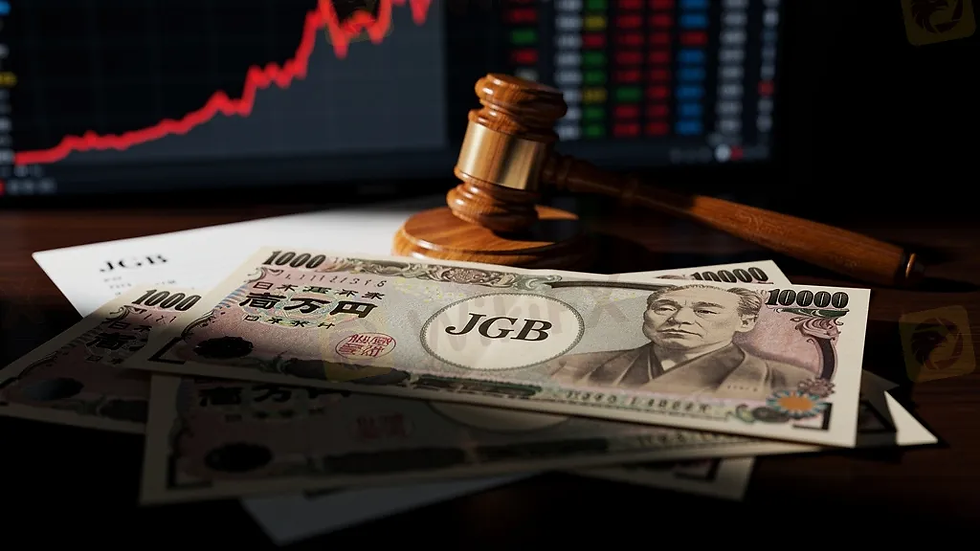
Diving deeper into Japan’s structural constraints, what jumps out immediately is the mountain of fiscal debt accumulated over the years. Its gross public debt stands as one of the highest in the world, with a debt-to-GDP ratio of more than 200%. With such a looming amount of debt, repayment obligations skyrocket. A simple 25 basis point increase in interest rates would raise a debt repayment of 1 billion by 2.5 million, a nightmare for fiscal planners. For a government managing more than twice its annual economic output worth of debt, the impact could potentially ripple into the billions. The knock-on effects would be painful: A raise in taxes? Perhaps a cut in public spending? Or raising even more debt?
Threading the fine line between raising interest rates to strengthen the yen and risking domestic fiscal meltdown is something that the BOJ is painfully aware of and actively trying to manage, yet paradise is nowhere close. Moreover, persistent deflation as a legacy of the 1990s remains a deep-rooted psychological trademark of the Japanese economy. Delayed spending, postponed investments, and stagnating wages as a result of deflation became everyday norms, and as the government scrambled to combat this by adopting negative interest rates and purchasing massive amounts of government bonds, it inadvertently created the conditions for households and businesses to grow accustomed to unusually low borrowing costs. To change this entrenched mindset comes at a painful cost.
Princess Mononoke’s Choice

Interest rates alone do not tell the full story. Looking at it in conjunction with the government’s broader economic strategy paints a fuller picture. Under Prime Minister Sanae Takaichi, Japan’s economic agenda seeks to revive long-term growth through increased government intervention, including initiatives like investing in strategic industries like defence, semiconductors, and artificial intelligence to increase Japan’s competitiveness in an increasingly fragmented world. Politically speaking, this strategy makes sense, as an ageing population, sluggish domestic growth and increased competition from powerhouses like China and Korea require Japan to target its key industries and create future engines of growth.
The problem lies in how it will be financed. Raising taxes on an already stagnant economy spells a recipe for disaster and political dissent, while the high debt-to-GDP ratio suggests that aggressive rate hikes will only raise debt-servicing costs to the limit and cripple fiscal prudence. The path of least resistance therefore lies in continuing to raise debt, financed in an environment with low interest rates. In other words, markets predict that loose monetary policy will hold for the foreseeable future as long as expansionary fiscal policy remains a highlight of Takaichi’s agenda. Although it is important to recognise that Sanaenomics did not directly cause the weakness of the yen, we must acknowledge that the expectations that come with the implementation of Sanaenomics have big ripple effects on foreign exchange markets.
Under the Hood
While intervention and monetary policy may temporarily solve the currency problem, it only cures the symptoms and not the flu. In the long term, currencies draw strength from competitiveness and strong economic fundamentals. Previously, the weak yen was considered an economic boon. Cheaper Japanese exports fueled an explosion in overseas demand for industries Japan excelled in, namely automobiles and machinery. But in this day and age, globalisation has shifted production patterns and forced Japanese firms to relocate production overseas, cutting off the link between a weak yen and high domestic production and employment. Its high dependence on imported energy and raw materials also means that the weak yen raises imported inflation from higher production costs and the erosion of household purchasing power.
Boosting its competitive advantage will make or break it for Japan. Prioritising investment in key areas like AI and semiconductors is a good start, and helps to future-proof the economy and develop key competitive advantages over its global rivals. Additionally, addressing deep structural challenges will be crucial in ensuring long term growth, as a labour crunch and ageing population currently plagues domestic productivity. Easier said than done.
The question of the ageing population has stumped administrations time and time again, but with increasing digitalisation and adoption of AI in the workforce, Japan might just catch a break this time round. Ultimately, currencies cannot be rescued indefinitely by intervention, but are rather a reflection of the economy behind them. Whether we see a strong yen in the future depends less on whether Japan intervenes now, and more on whether it can rediscover its sources of long-term economic dynamism.
Bibliography
Bacha, O. I. (2026, July 24). My say: Yen may be paying the price for its central bank’s follies. The Edge Malaysia. https://theedgemalaysia.com/node/811343
Bordier. (2025, November). The Takaichi trade. Bordier Monthly Market Update. https://www.bordier.com/wp-content/uploads/2025/11/Bordier-Monthly-Update-November-2025.pdf
Boughedda, S. (2026, July 17). Why the fed may still need to hike rates. Yahoo! Finance UK. https://uk.finance.yahoo.com/news/why-fed-may-still-hike-145209323.html
EAF Editors. (2025, December 8). Sanaenomics’ fiscal arithmetic doesn’t add up. East Asia Forum. https://eastasiaforum.org/2025/12/08/sanaenomics-fiscal-arithmetic-doesnt-add-up/
Galati, G., Heath, A., & McGuire, P. (2007, September 3). Evidence of carry trade activity. BIS Quarterly Review. https://www.bis.org/publ/qtrpdf/r_qt0709e.htm
Japan spent $73 billion in yen-buying intervention, ministry data shows. (2026, July 25). Investing.Com. https://www.investing.com/news/economy-news/japan-spent-73-billion-in-yenbuying-intervention-ministry-data-shows-4716415
OECD. (2026, July). Japan economic snapshot. OECD. https://www.oecd.org/en/topics/sub-issues/economic-surveys/Japan-economic-snapshot.html
Seah, H. S. (2026). Living with high debt in Japan – why market valuation matters - Asean+3 macroeconomic research office - AMRO asiaasean+3 macroeconomic research office – AMRO ASIA. In ASEAN+3 Macroeconomic Research Office - AMRO ASIA. https://amro-asia.org/living-with-high-debt-in-japan-why-market-valuation-matters
Sugiyama, K., & Kihara, L. (2026, July 22). Japan ready to take decisive currency action as yen hits 40-year low. Reuters. https://www.reuters.com/world/asia-pacific/japan-ready-take-decisive-action-forex-if-needed-finance-minister-says-2026-07-22/
Sugiyama, S. (2026, July 23). BOJ to raise rates again by December as weak yen revives inflation risks: Reuters poll. Reuters. https://www.reuters.com/world/asia-pacific/boj-raise-rates-again-by-december-weak-yen-revives-inflation-risks-2026-07-23/
Trading Economics. (2026a). Japan Interest Rate. Tradingeconomics.Com. https://tradingeconomics.com/japan/interest-rate
Trading Economics. (2026b). United States Fed Funds Interest Rate. Trading Economics. https://tradingeconomics.com/united-states/interest-rate
Xe currency converter. (2026, July 24). Xe.Com. https://www.xe.com/currencyconverter/convert/?amount=163.93&from=jpy&to=usd


Comments